

Whitepaper
1 Powering the Future of Long-Range Asset Tracking Labels
In today’s global supply chains, visibility is everything. Whether assets are stored in warehouses, shipped across continents, or handled by third-party logistics providers, knowing their condition and location in real time is no longer optional — it’s essential.
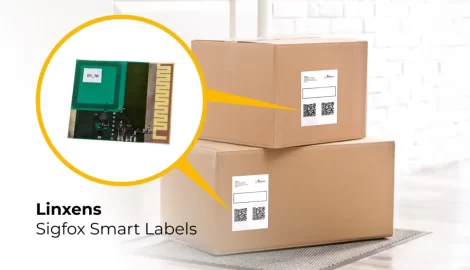
Smart asset tracking labels are transforming logistics by embedding advanced sensing and wireless communication directly into a printable adhesive label. These intelligent labels can monitor shock events, temperature excursions, humidity changes, and even detect package tampering — all through integrated accelerometers, temperature, humidity, and light sensors.
Even more impressively, these electronics are seamlessly integrated into labels that can still be printed using standard thermal printers — just like conventional logistics labels.
Once activated, the label begins transmitting sensor data wirelessly. And this is where one critical design decision shapes performance: the choice of communication technology — and the battery that powers it.
2 Why Choose Long-Range Connectivity?
Short-range technologies such as NFC, RFID, BLE, and WiFi work well when local gateway infrastructure is always nearby — typically within 1 to 50 metres.
But what happens when your assets move beyond that controlled environment?
If you require full end-to-end visibility — across warehouses, trucks, railcars, ships, and ports — long-range communication becomes invaluable. Maintaining permanent short-range gateway infrastructure along an entire journey is often impractical, especially when working with third-party logistics providers.
Long-range smart labels eliminate this dependency. They provide independence, data ownership, and continuous visibility — without relying on external infrastructure.
3 Long-Range Technology Options: Proprietary vs Cellular
Long-range connectivity falls into two broad categories:
3.1 Proprietary LPWAN Networks
Technologies such as Sigfox and LoRaWAN offer:
- Transmission distances up to 15 km
- Extremely low power consumption
- Operation in unlicensed frequency bands
- Low connectivity costs
These networks are ideal for corporate environments such as airports and ports, where secure, independent infrastructure is preferred and cellular vulnerabilities must be minimized.
3.2 Cellular IoT Networks
Cellular technologies leverage existing global mobile infrastructure, enabling worldwide connectivity without new network investment.
Options include:
- NB-IoT – ultra-low power, low data rate applications
- LTE-M – moderate data rates with low latency
- LTE Cat. 1 bis – high data rates (up to 10 Mbps), suitable even for video streaming
Cellular offers unmatched global reach — but with significantly higher peak current demands.
4 The Battery Challenge: Managing Peak Currents
Here’s where things get technically demanding.
Peak current requirements vary dramatically:
- Sigfox: 49–90 mA
- LoRaWAN: 30–130 mA
- NB-IoT / LTE-M: up to 500 mA
- LTE Cat. 1 bis: up to 900 mA
These high peak currents create a serious design challenge. Coin cells and energy harvesting solutions often struggle without bulky capacitors and complex power management circuits — increasing both cost and label thickness.
For thin, flexible asset tracking labels, that’s a problem.
5 Delivering the Power Cellular Labels Demand
Zinergy printed batteries are engineered specifically to meet these demanding requirements.
We have demonstrated:
- 900 mA pulse capability for one second
- Stable performance for NB-IoT and LTE-M applications
- Exceptionally low internal resistance (1.5–3 ohms)
Why does internal resistance matter?
Because when a cellular chipset draws 500 mA from a 3-ohm battery, the instantaneous voltage drop is 1.5 volts. At 900 mA, that drop increases to 2.7 volts — potentially causing system resets or brownouts.
Selecting the correct battery voltage becomes critical to maintaining reliable operation under peak loads.
6 Designing the Optimal Battery Configuration
Every application has unique constraints:
- Label size and thickness
- Required capacity
- Chipset voltage limits
- Environmental conditions
- Manufacturing robustness
- Cost targets
Because printed batteries are thinner than coin or pouch cells, larger surface area may be required to meet capacity targets. Where X-Y dimensions are constrained, vertical stacking offers an effective solution.
To further reduce voltage drop under high current loads, batteries can be connected in parallel — halving effective internal resistance while simultaneously increasing capacity. A true win-win.
7 Engineering Confidence Through Testing
Selecting the right battery isn’t guesswork — it’s engineering.
At Zinergy, we use in-house programmable battery testers that precisely replicate real-world current profiles for any selected wireless technology. We can evaluate performance under controlled temperature and humidity conditions to ensure robust operation before finalising product design.
Our team works closely with customers through every development phase — from initial concept to volume production — ensuring optimal battery performance, manufacturability, and cost efficiency.
8 Power Your Long-Range Labels with Confidence
If you’re developing thin, flexible asset tracking labels for cellular or LPWAN connectivity, choosing the right energy source is critical to success.
Zinergy delivers the power density, pulse capability, and design flexibility required for next-generation smart labels.
To discuss your application, contact us at [email protected].
We look forward to powering your innovation.